
 ultimate-guide
What to Look for in Backline: The Ultimate Guide
Table of Contents
- What to Look for in Backline: Core Criteria
- Understanding Backline Equipment and Stage Setup
- How to Write a Backline Rider
- Backline Rental Checklist: Pre-Event Verification
- Common Backline Rental Mistakes to Avoid
- Quality Assurance and Equipment Maintenance
- Backline vs. Front of House: Knowing the Difference
- Frequently Asked Questions
Last Updated: September 20, 2026
What to Look for in Backline: Core Criteria
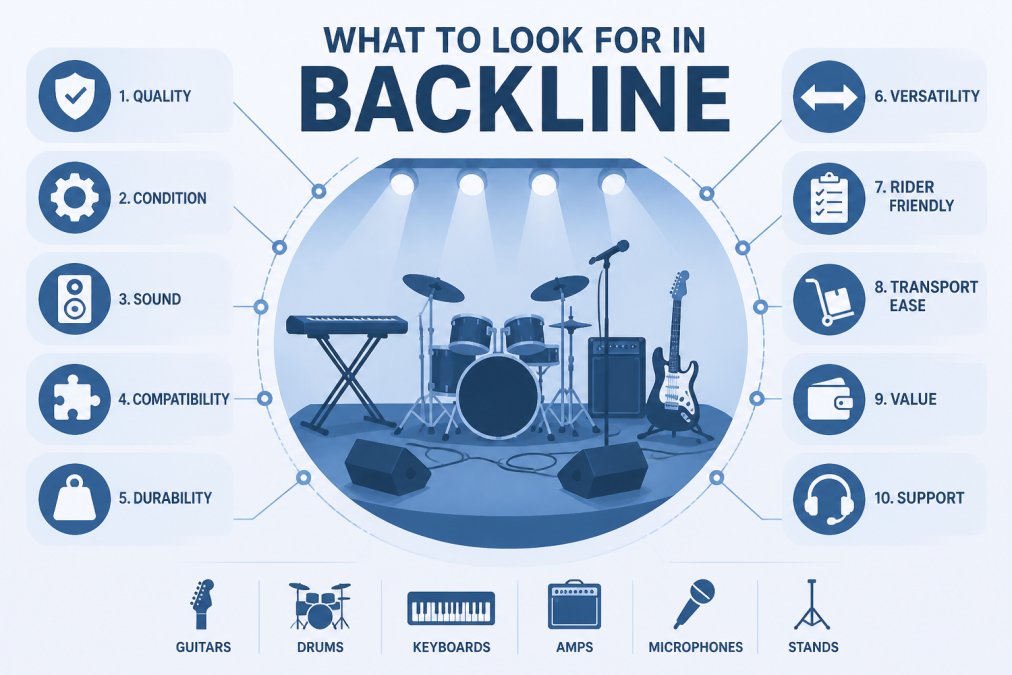
What to look for in backline means evaluating professional-grade musical instruments and audio equipment based on reliability, condition, technical specifications, and compatibility with your artist's rider requirements. At ORLANDO BACKLINE, we've spent decades helping touring musicians, event producers, and tour managers select gear that meets the most demanding performance standards.
The core criteria for backline selection center on three pillars: equipment condition and maintenance history, technical specifications that match your rider, and logistics support including load-in, setup, and sound check coordination. A touring act's success depends entirely on having the right gear in the right condition at the right time.
Most bands and event planners overlook a critical step: verifying that rental equipment matches their exact specifications before the performance date. This isn't just about having drums or a keyboard on stage, it's about having the exact drum kit configuration, the specific amplifier models, and the proper cabling infrastructure that your artists expect. A mismatched setup can derail a performance or force last-minute substitutions that compromise sound quality.
Understanding Backline Equipment and Stage Setup
Professional backline encompasses all instruments and amplification equipment positioned on stage, excluding front-of-house (FOH) systems. The stage plot, a technical drawing that shows equipment placement and power requirements, is your roadmap for what needs to be in place.
When evaluating backline, you're assessing multiple equipment categories simultaneously. Each has distinct technical requirements and maintenance considerations. Understanding what belongs in each category helps you write accurate riders and verify that rental companies can fulfill them.
Drums and Percussion
A drum kit forms the rhythmic foundation of most performances. When selecting backline drums, inspect the shell condition, bearing edge integrity, and hardware functionality. The specific drum configuration matters enormously, a 4-piece kit (kick, snare, tom, floor tom) differs fundamentally from a 5-piece or 6-piece setup.
Cymbal stands must support the weight and positioning of crash, ride, and hi-hat cymbals without wobbling. Check that stands have proper counterweights and that clutches secure the cymbals firmly. Missing or damaged cymbal stands create safety hazards during performance and compromise sound quality.
Drum thrones should have adjustable height mechanisms and stable bases. A wobbly throne affects a drummer's timing and comfort during a full set. Pedal functionality, both kick pedal responsiveness and hi-hat pedal tension, requires hands-on testing before the performance date.
Amplification and Cabling
Amplifiers, whether for bass, guitar, or keyboards, must deliver clean power at the required wattage. A 100-watt amp serves different purposes than a 50-watt or 200-watt configuration. Inspect speaker cones for tears, test all input channels for signal integrity, and verify that cooling fans operate properly.
Cabling infrastructure includes instrument cables, speaker cables, XLR microphone cables, and power distribution. Damaged cables introduce noise, signal loss, or complete connection failure. A single bad cable can disable an entire signal chain. Request that rental companies provide backup cables for every connection type specified in your rider.
DI boxes (direct injection boxes) convert high-impedance instrument signals to low-impedance microphone-level signals suitable for mixing consoles. Verify that DI boxes include ground lift switches and proper input/output configurations matching your audio engineer's requirements.
Power requirements vary by equipment. Amplifiers, keyboards, and stage monitors all draw significant current. Confirm that the venue's electrical infrastructure supports the total power draw and that the rental company provides proper power distribution units with surge protection.
Keyboards and Keys
Keyboard instruments range from weighted 88-key controllers to portable synthesizers. The touch and response of keys affect a performer's ability to deliver consistent dynamics. Test that all keys respond to velocity sensitivity and that sustain pedals function properly.
Sound module functionality, whether built-in or requiring external gear, must match the artist's specifications. Some performers require specific synthesizer models; others need weighted pianos with hammer action. Verify that the keyboard includes all necessary sound banks and that MIDI connectivity works if sequencing is part of the performance.
Keyboard stands and sustain pedals must be stable and responsive. A poorly positioned keyboard or sluggish pedal creates performance challenges that can't be corrected mid-show.
How to Write a Backline Rider
A backline rider is a technical document that specifies exact equipment requirements for a performance. It's part of your overall technical rider and serves as the contract between your act and the venue or rental company. A well-written rider prevents surprises and ensures that your technical needs are communicated clearly.
Essential Sections of a Technical Rider
Start with a stage plot, a scaled diagram showing equipment placement, dimensions, and power locations. Include measurements for stage footprint, equipment spacing, and access points for load-in. A clear stage plot eliminates ambiguity about what fits on stage.
List every instrument and piece of amplification equipment by brand and model. Don't write "drum kit", specify "Yamaha Recording Custom 5-piece kit with Zildjian cymbals." This level of detail ensures the rental company knows exactly what to provide.
Include an input list that details every microphone, instrument input, and direct injection point that feeds into the mixing console. Specify which channels go to monitors (stage speakers for performers) and which go to front-of-house. This list guides your audio engineer and the venue's technical staff.
Detail power requirements in watts and specify voltage (110V or 220V depending on venue location). Include the total amperage draw so the venue can confirm adequate electrical service. Note any special grounding requirements or isolation transformer needs.
Specifying Exact Gear Models and Configurations
Rather than requesting generic categories, specify exact models and configurations. A "Marshall amplifier" means nothing without model designation. "Marshall JCM800 100-watt head with 4x12 cabinet" is precise and actionable.
For drums, specify the exact configuration: "Ludwig Classic Maple 5-piece shell pack with 22-inch kick, 10-inch tom, 16-inch floor tom, 14-inch snare." Include cymbal specifications: "Zildjian K Custom 14-inch hi-hats, 18-inch crash, 20-inch ride."
For keyboards, include the model name and any required sound modules or synthesizers.
Backline Rental Checklist: Pre-Event Verification
Before your performance date, conduct a systematic verification that all equipment matches your rider specifications. This checklist approach catches problems before load-in when there's still time to source alternatives.
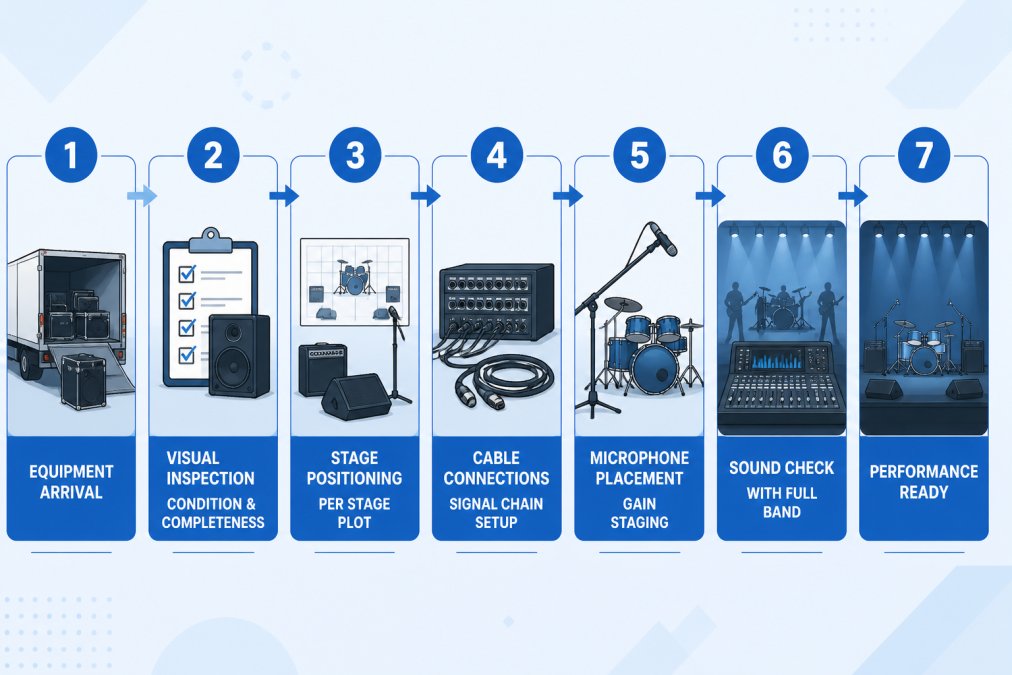
Equipment Verification Checklist:
- Confirm all drum kit components are present and match specified models
- Test all amplifiers for clean power delivery and proper input/output functionality
- Verify all cables are present, undamaged, and correct type for each connection
- Test all instruments for responsiveness and proper mechanical function
- Confirm stage plot dimensions match venue stage size
- Verify power distribution units include adequate circuits for total amperage draw
- Test all microphone and instrument cables for continuity and signal integrity
- Confirm backup equipment is available for critical items
- Verify DI boxes have proper ground lift switches and impedance matching
- Check that keyboard stands are stable and sustain pedals respond properly
Load-In and Venue Logistics
Load-in, the process of moving equipment from trucks into the venue, requires coordination between your cartage team, the venue's stage management, and the rental company's technicians. Confirm the load-in time, door access, and parking for equipment trucks. A smooth load-in prevents delays and damage to gear.
Sound Check and Signal Chain Testing
Sound check is your opportunity to verify that all equipment functions properly and that every signal path works correctly. Start with a complete channel-by-channel test: each microphone, each instrument input, and each direct injection point should produce clean signal at the mixing console.
Common Backline Rental Mistakes to Avoid
Many touring acts and event producers make predictable errors when selecting or preparing backline equipment. Understanding these mistakes helps you avoid them.
Quality Assurance and Equipment Maintenance
Professional backline rental companies maintain their equipment to exacting standards. Equipment that meets the demands of touring musicians requires consistent maintenance and inspection.
Backline vs. Front of House: Knowing the Difference
Backline and front-of-house (FOH) systems serve different functions and require different expertise. Understanding the distinction helps you allocate resources correctly and communicate with your technical team.
Frequently Asked Questions
What is typically included in a professional backline rental?
A full backline typically includes drums with cymbal stands, amplifiers for guitars and bass, keyboards, DI boxes, cabling, and risers for stage layout. Partial backline rentals may exclude certain instruments. What you receive depends on your technical rider and the rental company's inventory. Professional rental companies like ORLANDO BACKLINE source exact gear models specified in your artist rider to ensure your performers get the equipment they need for a successful show.
What should I include in a backline rider to get exactly what I need?
Your backline rider should specify exact drum kit configurations (shell sizes, finishes, cymbals), amplifier models and wattage, keyboard types and sound modules, microphone placements, DI box requirements, and power specifications. Include a stage plot showing equipment placement and a patch list detailing signal flow. Be specific about voltage requirements and any unique gear needs. Providing a detailed technical rider prevents surprises and ensures the rental company can source your exact specifications before load-in.
How far in advance should I book backline for a live performance?
Book backline as soon as your lineup and technical requirements are finalized. For festivals and large tours, 4-6 weeks advance notice allows rental companies to source specific gear models and coordinate cartage and setup logistics. Shorter tours or single-show bookings can often be accommodated with 2-3 weeks notice, depending on equipment availability. Early booking also gives you time to refine your technical rider and coordinate with the venue on stage footprint and power requirements.
What are the most common mistakes when requesting backline for events?
Common mistakes include vague gear specifications, failing to account for voltage differences across venues, not communicating stage plot requirements to the rental company, and underestimating setup time during load-in. Musicians often forget to list cables, adapters, and DI boxes, leading to incomplete setups. Another frequent error is booking without confirming the rental company's maintenance standards or backup equipment availability. Clear communication and detailed riders prevent these issues and ensure a smooth, professional performance.
What is the difference between full backline and partial backline?
Full backline includes all instruments and amplification needed for a complete band performance: drums, bass amp, guitar amp, keyboards, and all cabling and support gear. Partial backline means you rent only some instruments or amplification, typically because the touring act is bringing certain gear. For example, a band might rent drums and keys but bring their own guitar amps. Your technical rider and stage plot determine which approach makes sense for your production.